

Hey friends 👋
It’s 11 pm and you’re on your 19th version of your pitch deck… maybe even just for today.
Tonight you moved the traction slide ahead of the team slide because some VC firm on LinkedIn said that’s what serious founders do. Yesterday, you rebuilt the TAM graphic in Canva because an advisor told you to. Last week, you rewrote the entire problem statement four times and made your co-founder vote on taglines without a single discussion of what customers actually shared.
You’ve pitched eleven investors since spring. Eleven passes. After every single one, you opened the deck that same night and started editing.
You feel productive. Version 19 is objectively sharper than version 18. Your co-founder sees you grinding at midnight and assumes the company is moving.
And your last conversation with an actual customer was in June.
Let’s dive deep ⬇️
You might be a tweaker
On a recent podcast episode we gave this founder a name: the tweaker.
A tweaker treats the pitch deck as the job. They tweak between every investor or advisor meeting. They tweak after every piece of feedback. They tweak when they’re anxious, when they don’t know what else to do. The deck becomes a comfort object with a version history.
Tweaking is procrastivity in its purest form: work that feels productive while you dodge the work that decides whether you have a company. This is all motion with nothing to show for it.
And it’s seductive for good reasons.
1. Tweaking is motion you control
Validation work is scary. Cold outreach gets ignored. Discovery calls surface problems with the idea you love. Asking a prospect for money invites a no from a real human being who could crush your dream in one sentence.
Deck work carries none of that risk. Figma, Lovable, Canva, good old PowerPoint. No matter the tool, it never rejects you. Every edit produces instant, visible improvement, and you get to be the judge of it. Nudge a logo two pixels left and collect the dopamine.
So when validation stalls, founders retreat to the deck. From the outside it looks exactly like company-building. Inside, it’s a founder polishing a mirror instead of looking through a window.
Meanwhile the thing investors are evaluating, the business underneath the slides, hasn’t changed at all.
2. A deck reports evidence. It cannot create evidence.
Every slide in your deck is a claim. Customers have this problem. The market is this big. We can acquire a customer for this much. People are paying us. Stack the slides together and you have your theory of the startup: the claims, and the evidence behind them, for why this company should exist and why it deserves funding.
The deck’s entire job is to communicate the receipts behind those claims.
Receipts make the deck easy. A traction slide that says 14 paying customers, 92% monthly retention, and a $340 blended CAC against a $1,200 LTV needs zero design flair. An investor reads past mediocre formatting to real evidence in about ten seconds.
Tweaking is what happens to a deck with no receipts. You can reorder the slides, punch up the headlines, swap the template, and the business is no more credible for any of it. The traction slide still has nothing on it. A gorgeous empty slide is still an empty slide.
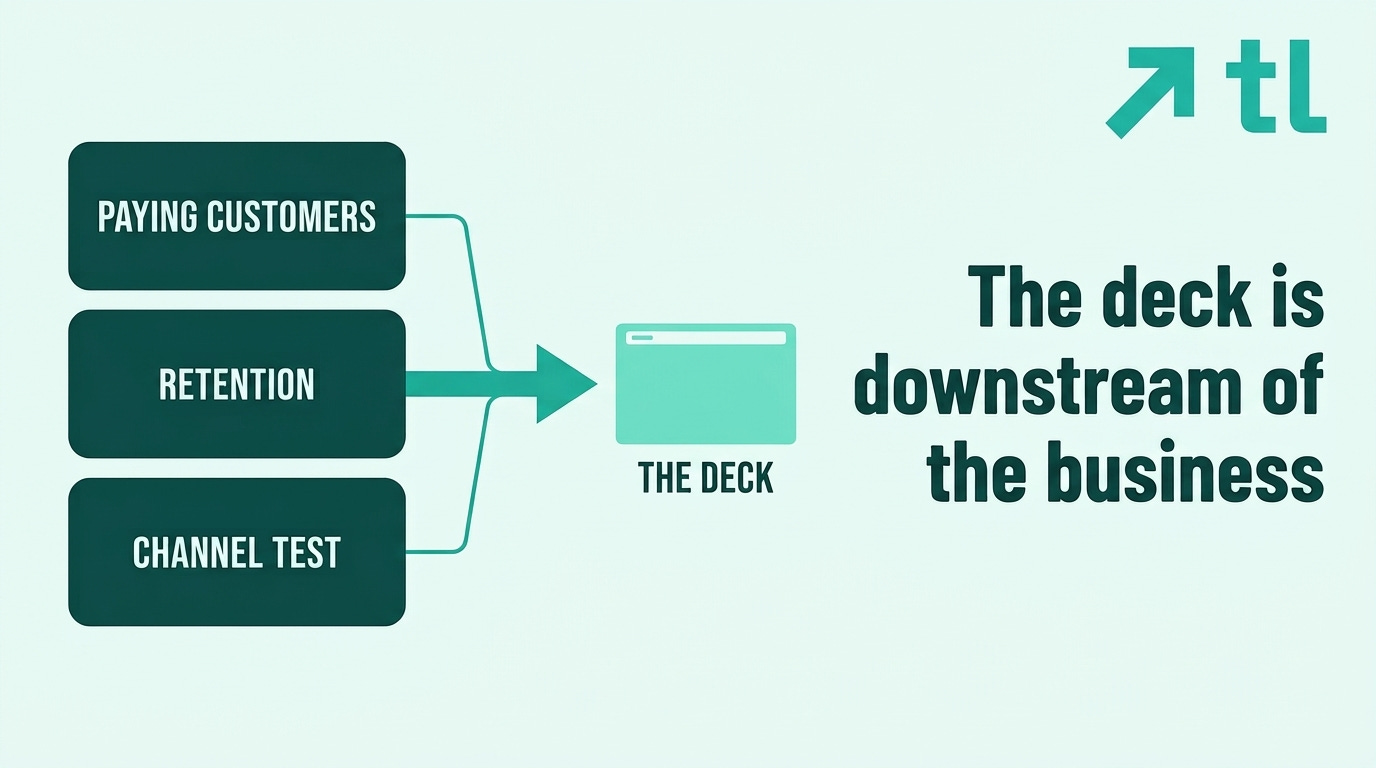
No amount of design produces evidence that doesn’t exist. The deck is downstream of the business. Always.
3. Tweakers misdiagnose every no
Watch what happens after an investor says no to a tweaker.
They replay the meeting and fixate on the moment the energy dipped. Slide 9. That’s where we lost them. So they rebuild slide 9, reorder the narrative, and book the next pitch with the confidence of someone who just fixed the problem.
Except investors pass on missing evidence far more often than they pass on messy slides. No proof anyone will pay. No repeatable way to reach customers. A market claim built on hope math, or as we say, hopium. Those are business gaps, and business gaps close through validation work: conversations, experiments, asks, commitments with terms attached.
Picture a founder selling scheduling software to home services companies. They pitch 14 investors over a quarter and produce 11 deck versions along the way. Same core objection every time: no evidence contractors will pay. The founder hears a storytelling problem 14 times in a row. Three signed pilots with payment terms would answer the objection permanently. Version 12 cannot, and neither can version 20.
You cannot design your way out of a validation gap. Every hour spent trying is an hour the gap gets wider.
And sunk cost keeps you in the loop. You’ve poured so many hours into the deck that it feels like it should be producing better results by now, which makes version 18 feel like the reasonable next move.
4. Run the version-to-conversation ratio
Two numbers. Pull them right now.
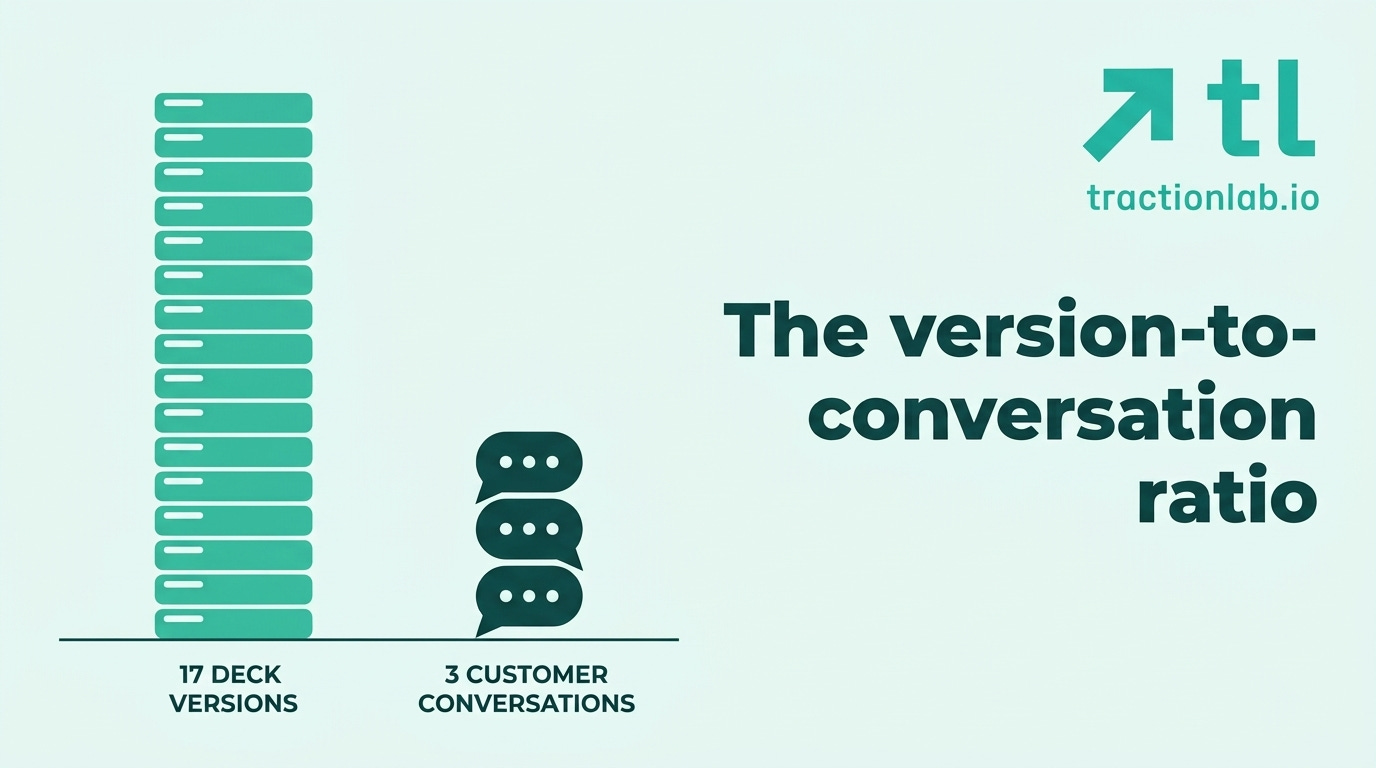
How many deck versions have you created this quarter?
How many conversations have you had with customers or prospects this quarter?
If versions outnumber conversations, well… you’re a tweaker.
A healthy deck version gets forced into existence by new evidence. You closed three pilots, so the traction slide changes. You killed a segment after 20 discovery calls, so the customer slide changes. A channel test converts at 4%, and the go-to-market slide changes. Evidence moves first. The deck follows.
When the version number climbs and the evidence stands still, every one of those edits was a tweak. Cosmetic churn on a business that isn’t moving.
The math
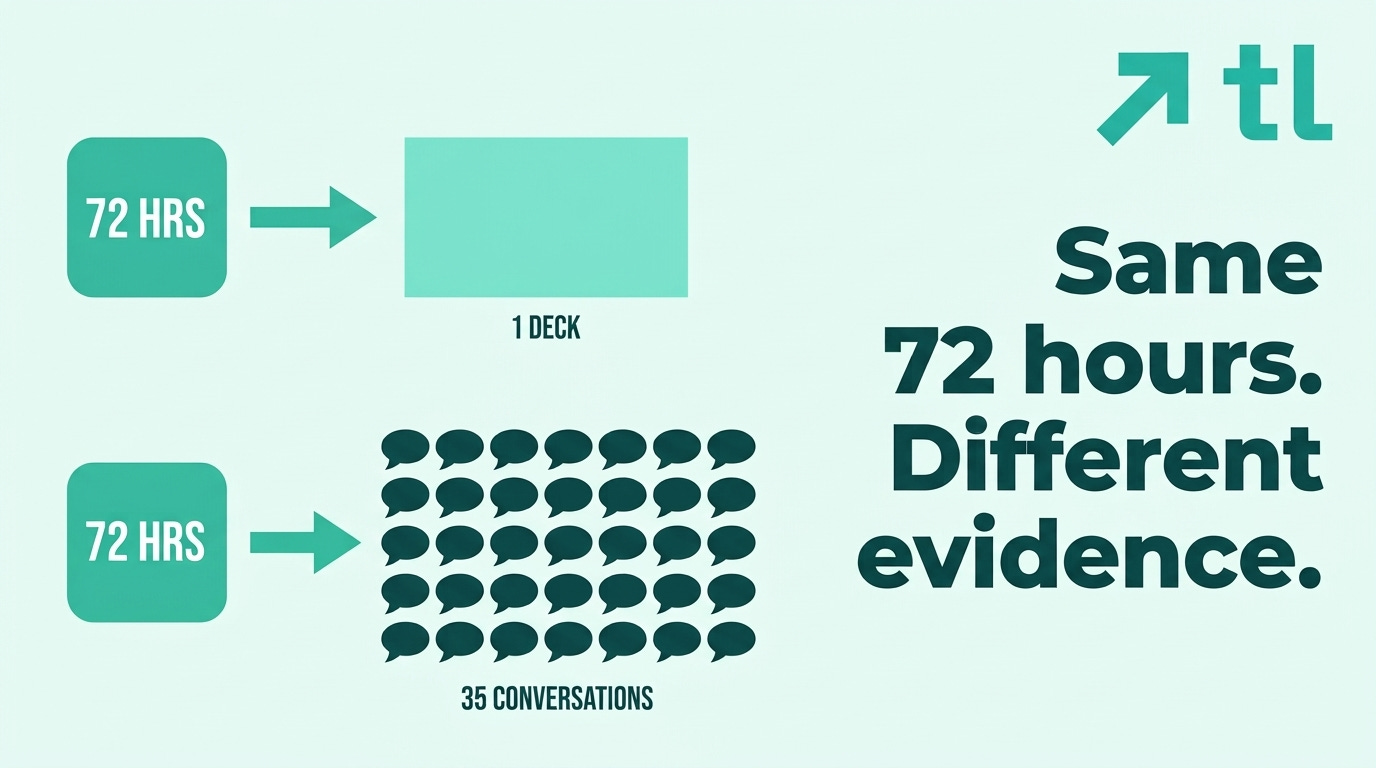
Say you spend six hours a week on the deck. Modest for a committed tweaker. Over a 12-week quarter, that’s 72 hours.
Now run those same 72 hours through validation work instead.
Budget roughly one hour per completed discovery conversation once you account for outreach, scheduling, the call, and notes. That’s 72 conversations with real prospects in a single quarter. Even at half that pace, you’d land 35 conversations.
35 conversations is enough to map a problem landscape, kill two bad segments, and surface the small handful of desperate buyers worth pursuing. It’s enough to make three real asks with terms attached and find out who follows through.
72 hours of tweaking produces a deck.
And the cruel part: the conversation path is also the fastest route to a better deck. Those 35 calls generate actual material. Direct quotes about urgency. A segment you can actually name. Maybe a signed pilot. The deck you’d build after that quarter beats version 17 without touching a single font, because it finally has something to say.
The tweaker path costs you the quarter twice. Once in the hours spent, and again in the evidence you never collected.
What to do this week
Freeze the deck. Thirty days… no edits. Can you do it?
One exception: new evidence unlocks it. A signed pilot with success metrics and payment terms. A paying customer. A conversion number from a real channel test. If the business gives the deck something new to say, open it and say it. Anxiety doesn’t qualify.
Then take the hours you just recovered and book five prospect conversations this week. Prospects. The people whose commitments eventually fill the traction slide with something worth reading.
Your deck should be the most boring document in your company: a plain report of what the business has proven so far. Go make the business worth reporting on.
Until next week,
Cam