
Don't delegate your fear
The Founder Arc, the 40-Before-Delegation Rule, and why your next hire should scale a motion you already proved.

Hey friends 👋
You closed your first eleven customers yourself. Every one was a grind. The awkward pricing conversations. The follow-ups that felt like begging. The demo where you watched the buyer’s eyes drift to their second monitor.
You hate it. So you do what every advisor, podcast, and LinkedIn carousel tells you to do: hire someone great and get back to what you are best at.
Enter the AE with the shiny resume. $140K OTE, logos from two Series B companies, speaks fluently about pipeline discipline.
Ninety days later: zero closed deals. Your warmest leads have gone quiet. And you genuinely cannot tell whether you hired the wrong person or handed them a pitch that never worked in the first place.
That ambiguity is the expensive part. You paid six figures to learn nothing.
Let’s dive deep 👇
The Founder Arc
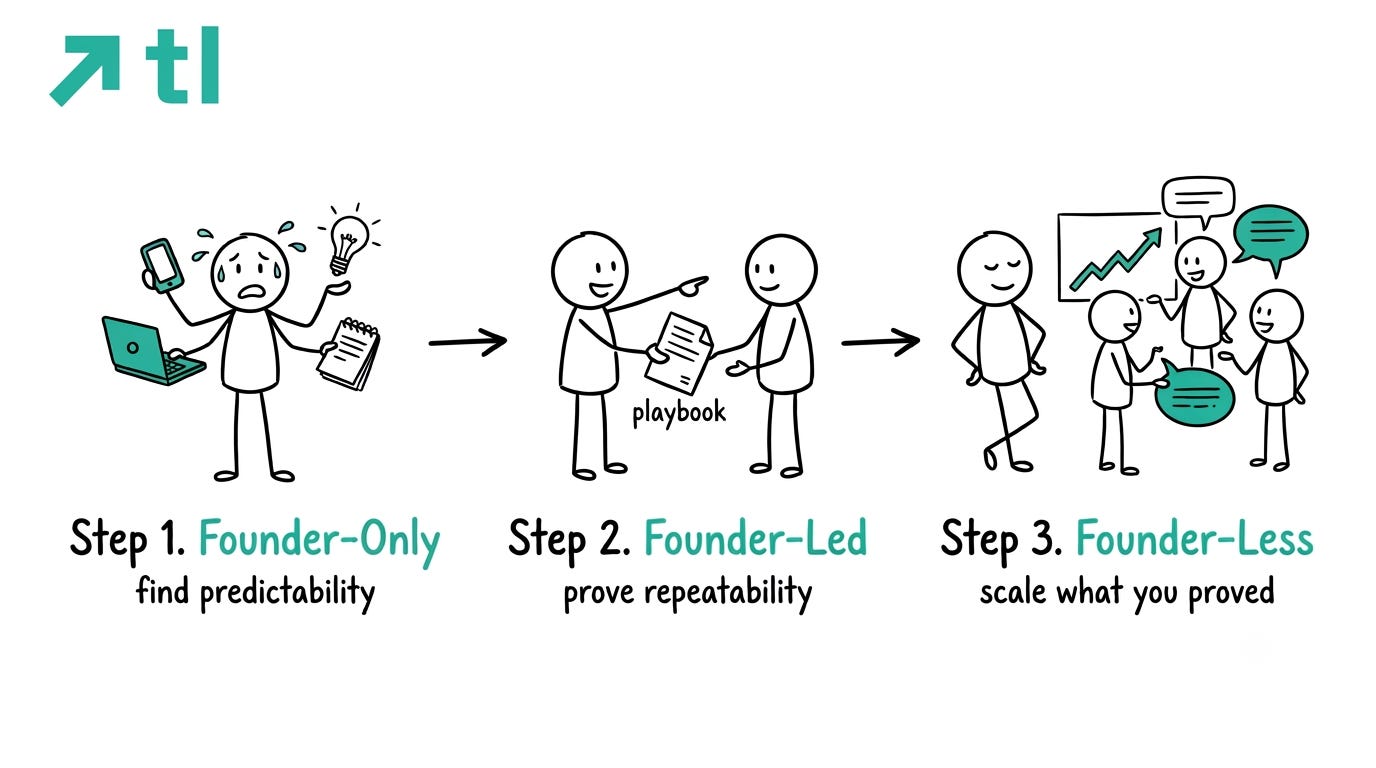
Every critical function in your startup travels the same three stages: Founder-Only, then Founder-Led, then Founder-Less. We call this the Founder Arc, and it maps directly onto the progression we teach for every growth engine: predictable, then repeatable, then scalable.
Founder-Only is where you find predictability. Founder-Led is where you prove repeatability. Founder-Less is where you scale what you proved.
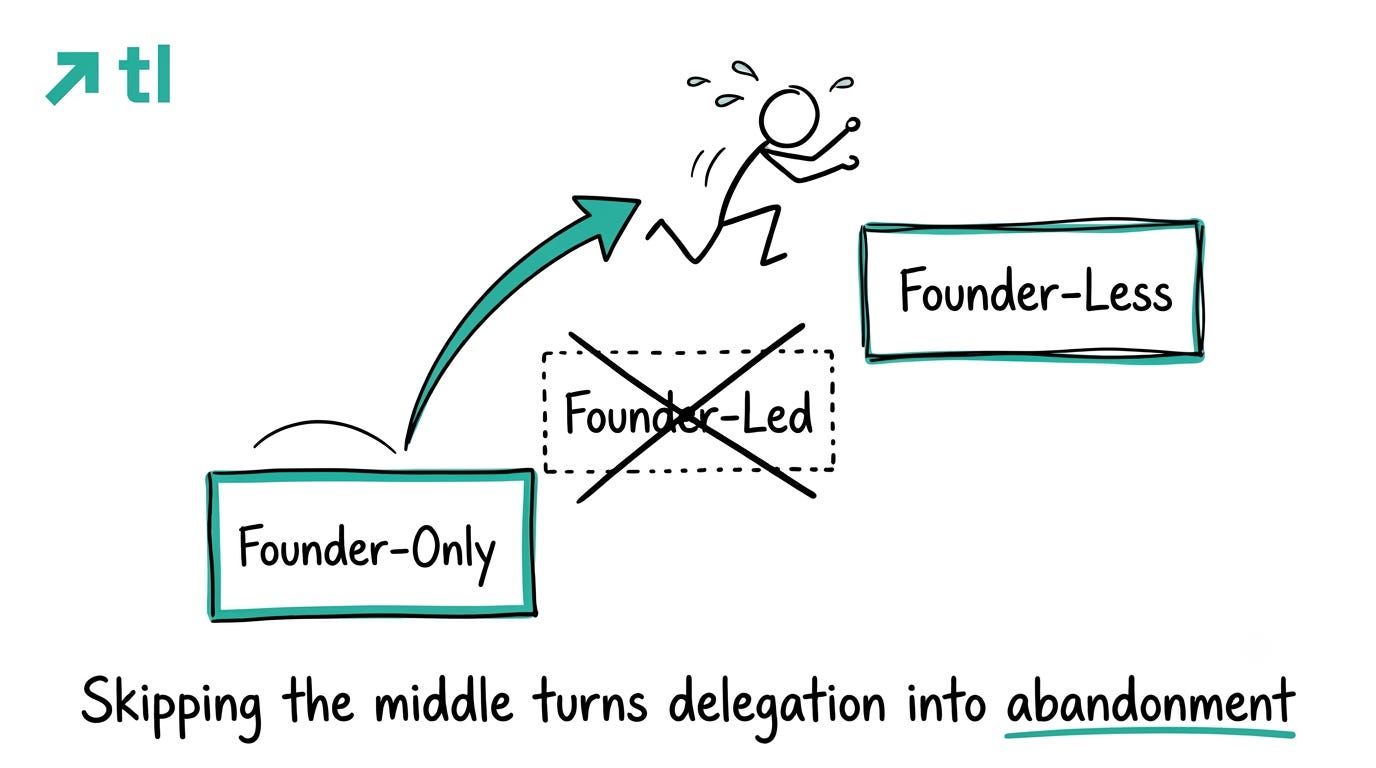
The founder in the hook jumped from stage one straight to stage three and skipped the middle entirely. The middle is where the actual handoff happens.
And the arc covers more than sales. Product decisions, support, onboarding: every core function walks the same path, and every one fails the same way when a stage gets skipped.
1. Founder-Only: do the scary thing until it gets predictable
This stage is data collection, and you are the only instrument sensitive enough to run it.
In sales, that means you take every call. You hear the same objection for the fifth time and notice it only shows up at companies under 50 employees. You watch deals close fast when the buyer just lost a key employee to the problem, and stall forever when they found you through a webinar. You learn the exact words customers use to describe their pain, and those words become your outbound.
In product, it means you sit in the discovery calls and make the roadmap calls yourself. You watch a customer limp through their duct-taped workaround on a screen share and learn what must-have actually means. You ship the wrong thing once, feel it, and never again prioritize by loudest voice.
What you are building is pattern recognition you cannot buy back later. The question JDM asks every founder at this stage:
Can you separate what worked from what happened to work?
Your first wins are full of noise. Warm intros. Lucky timing. A buyer who turned out to be your college roommate’s boss. Founder-Only is how you learn which wins were the motion and which were just the weather.
Skip this stage and those learnings evaporate. A hired rep hears a fatal objection, logs the deal as lost to price, and moves on. You would have heard the same objection and recognized a mispositioned value prop.
2. Founder-Led: the step almost everyone skips
Founder-Led is a light delegation. Your first hire works beside you, not instead of you.
Concretely: you run the calls while they shadow. Then they run the calls while you shadow. Every place their motion deviates from yours becomes a coaching note or a playbook edit, because sometimes their deviation is the improvement.
This is where repeatability gets proven, and the definition matters. Repeatable means someone who is not you can execute the motion successfully. You do not know whether your playbook is real until it survives contact with another human. Until then it is a pile of things that worked for the founder, which is a different document.
The product version: your first product hire makes prioritization calls inside your framework while you stay in the customer conversations. You review their decisions against your rubric every week. When their calls and yours converge for a full quarter, the function is ready to leave home.
Founders skip this stage for an honest reason: it does not relieve the discomfort. You are still doing the scary thing, now with an audience, and it feels slower than handing over the keys.
We see the move constantly: a founder maxed out on sales plans to exit it entirely before their first hire has closed a single deal. Skipping the middle turns delegation into abandonment. The hire inherits a job with no map, and when they fail, the founder concludes sales does not work for this business.
3. Founder-Less: scale the channel you proved
Founder-Less is where every function should eventually land: sales that closes without you, product that ships without you. The only open question is when you have earned the handoff.
The graduation test is repeatability alignment across five elements: same customer profile, same urgent and severe problem in the same language, same channel to reach them, same motion in the conversation, same objections. Five for five, and someone other than you has run the motion successfully without you in the room.
Pass that test and hiring becomes a math question: add input and output grows at least in proportion, hopefully better. Proportional is the floor, and the playbook is what pushes past it. Rep two ramps on a documented motion instead of rediscovering one, so each unit of input buys more output than the last. You are fueling an engine.
Hire before that test and you are buying parts for an engine that does not exist.
The arc fails in the other direction too. Some founders never leave stage one. The bottleneck founder has a favorite line: nobody understands our customers like I do. That founder is still personally approving every ticket at month 30, and the company ships at the speed of one calendar. Founder-Only is a stage, and camping there caps your company at the size of your week.
The trap: hiring away your discomfort
The tell that you are about to skip a stage: you are delegating a function because it is painful, while telling yourself it is because you are strategic.
Sales feels gross, so you hire a head of sales. Code is intimidating, so the dev shop owns product decisions while you focus on strategy and fundraising. Whatever that means.
You have confused not being naturally good at something with not needing to learn it. Nobody is naturally good at founder sales. The founders who look like naturals did their reps in private.
So we hold a hard line here, and we gave it a number.
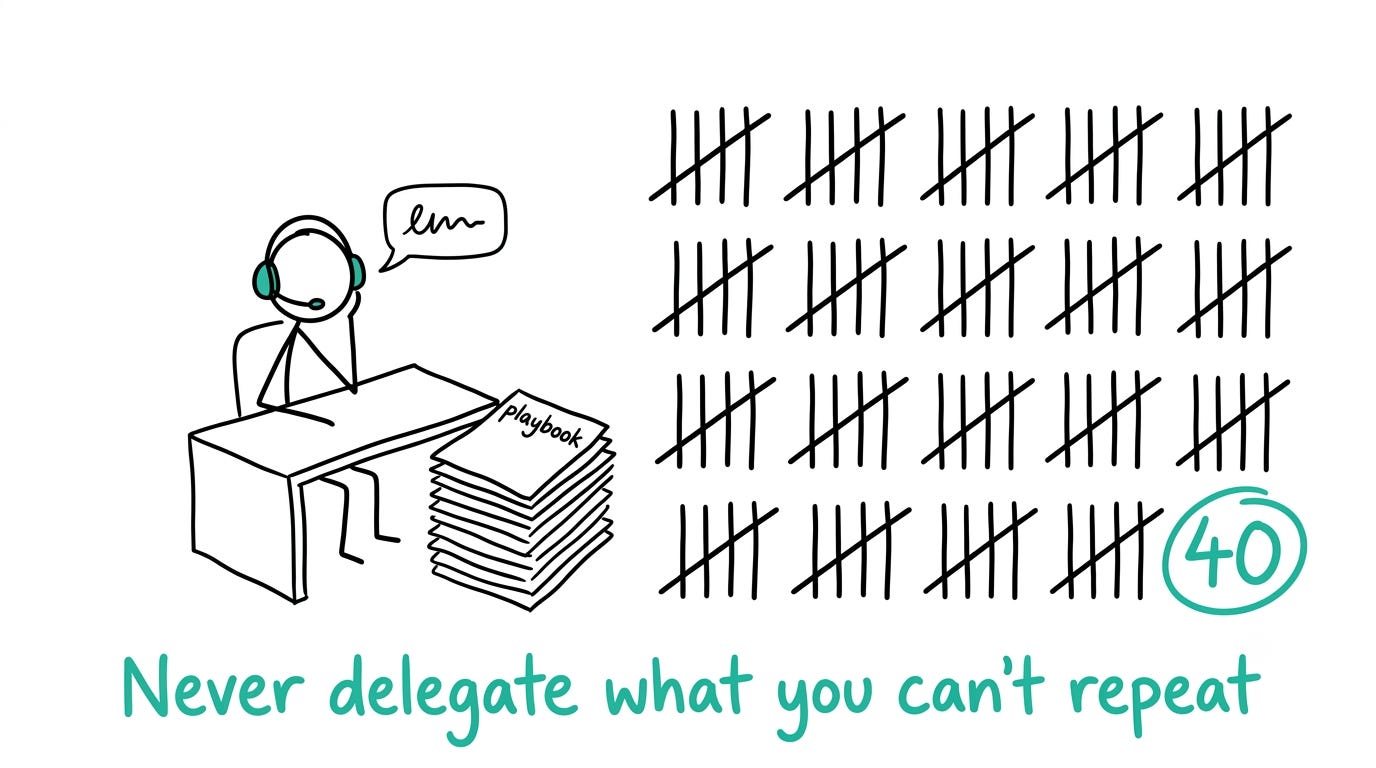
The 40-Before-Delegation Rule: do the critical function yourself, successfully, at least 40 times before you hire someone to own it.
In sales, that is 40 complete reps through your motion, first touch to close or clear loss. Wins and losses both count, and the losses carry most of the information. This is where true learning happens.
In product, that is 40 prioritization decisions you made, shipped, and scored against what actually happened.
If you cannot write the job description with specific success metrics and staple a playbook to it, you are too early. Never delegate what you cannot repeat.
The math on skipping the arc
Run the numbers on the founder from the top of this article.
A $140K OTE rep costs roughly $75K for six months, fully loaded. Handing them an unproven motion means running an experiment with two unknown variables at once: does the motion work, and can this person execute it.
When the experiment fails, you cannot attribute the failure. Wrong pitch? Wrong customer profile? Wrong channel? Wrong hire? Any of the four explains zero closed deals, so you eliminated none of them. $75K and two quarters, spent to stay exactly as confused as you started.
The part that hurts more than the cash: an early-stage startup with a tight beachhead might have 60 genuinely qualified prospects in reach right now. A rep learning an unproven motion burns 20 of them. Those leads do not regenerate next quarter. Time comes back. Money sometimes comes back. A torched beachhead does not.
Compare the alternative. Forty founder-run reps cost you zero incremental cash and isolate exactly one variable: the motion. Every lost deal teaches you something true about the pitch, because you know it was delivered the way you intended. That is the cheapest signal available anywhere in your company, and delegating early trades it away for comfort.
Do this before your next hire
Pick the function you most want off your plate. Be honest, it is the one you just thought of.
Count your reps. Complete executions of the full motion, not meetings attended.
Under 40? You have your answer and your calendar for the next eight weeks. Book the next five reps this week, and write one playbook entry after each: what you said, what they pushed back on, what you will change.
At or past 40? Write the playbook before the job description. Customer profile, problem language, channel, motion, objections with answers. All five, in writing. Then make your first hire a Founder-Led hire: run ten reps beside them, and hand over the pen only when their results look like yours.
Until next week,
Cam