
🧠 High Conviction Founder Series: They test what could kill them
Your logo can't reject you. Your wireframes will never say no. Your customers will. Habit #1 of high conviction founders: test what could kill you first.

Hey friends 👋
You’ve had the idea since January.
February went to research. Market sizing, competitor teardowns, average revenue per customer, every report you could pull without leaving your desk. Boy was that comfortable.
March went to the build. Clickable wireframes. A brand identity. A logo, a color palette, a landing page that would make a design agency jealous.
April finally arrives and you talk to four potential customers. Four. Two of them say the problem is real.
Ninety days of work. Two data points. That’s the entire evidence base for whether this company gets to exist, and a phone call in week one would have bought it for the price of a coffee.
Everything you built in February and March was downstream of an answer you didn’t have.
You built an artifact museum. And nobody’s buying a ticket.
Let’s dive deep 👇
A new series: the habits of high conviction founders
We spend our weeks inside validation roadmaps, screening interviews, and pitch reviews. After enough reps, you start seeing the same separation over and over.
Some founders build with conviction. They walk into an investor conversation with this conviction and transfer it through evidence, because every belief they hold is backed by something they did, measured, and can be defended.
Other founders build artifacts. Decks, prototypes, brands, dashboards. Lots of motion. No idea whether the company should exist... Startup theatre.
The difference comes down to habits. Small, repeated choices about what to work on when nobody is forcing the choice. So we’re starting a series on the habits that make for high conviction founders.
This is Habit #1, and it’s the one all the others depend on:
High conviction founders test what could kill them.
The quadrant where startups die
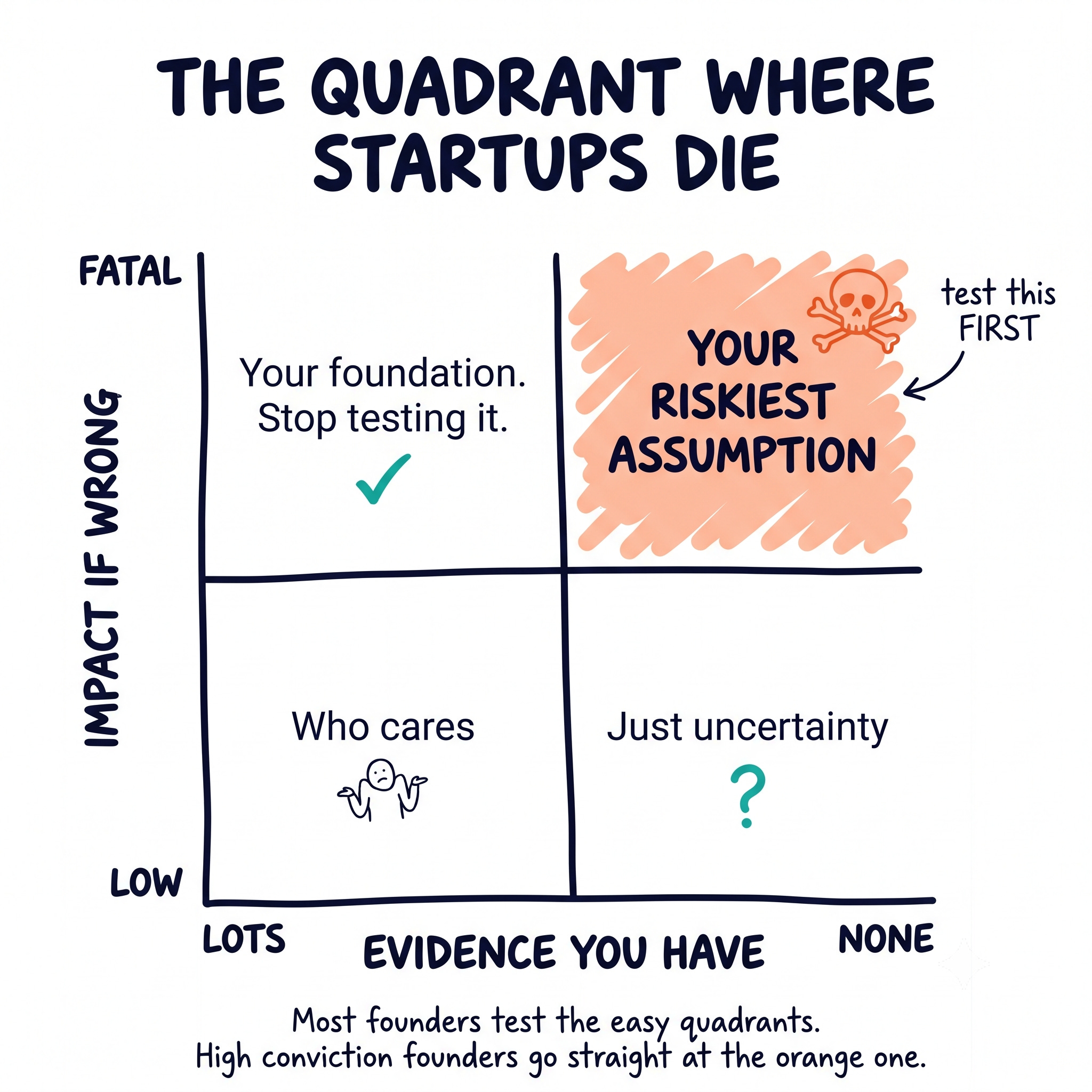
Your startup is carrying dozens of assumptions right now. Most of them are safe. A few of them are fatal.
Sort every assumption on two axes: how much damage it does if you’re wrong, and how much evidence you have that you’re right.
High impact, high confidence. That’s your foundation. You’ve already proven it. Stop testing it.
Low impact, low confidence. That’s just uncertainty. It won’t make or break you.
Low impact, high confidence. Who cares.
High impact, low confidence. That’s the quadrant where startups die. An assumption that would destroy the business if wrong, supported by little or no evidence. That’s your riskiest assumption, and high conviction founders go straight at it.
Most founders do the opposite. They test what’s easy instead of what’s risky. They A/B test the logo when they don’t know if anyone wants the product. That’s rearranging deck chairs while the ship sinks.
The kill-question changes as you grow, but there’s always exactly one at the front of the line:
Pre-product: does this customer have this problem with enough urgency and severity to pay for a solution now?
Post-product, pre-revenue: will people actually pay, or just use it for free?
Early revenue: can we acquire customers predictably and profitably?
Scaling: do our unit economics hold at volume?
If you can’t name yours in one sentence, that’s the first problem to fix.
Why you keep testing the wrong quadrant
You already know which assumption could kill your startup. Somewhere in the back of your mind, you’ve known for months.
So why are you refining the pitch deck?
We call this procrastivity. Productive procrastination. All motion, no progress on the thing that matters. You’re working twelve-hour days, and every one of those hours is pointed away from the question that decides everything.
And it makes sense, because the kill-question is the scariest one on the board. Testing it means putting your dream in front of someone who can crush it. That sh** is vulnerable.
The logo can’t reject you. The landing page can’t tell you the problem isn’t urgent. The wireframes will never say no.
So you delay. And every delay is delayed learning, because you can’t learn anything until something gets in front of a customer. The customer decides if you succeed or fail. Nobody else gets a vote.
A team we watched had a customer call booked two weeks out. One prototype built, ready to show. They spent the entire two weeks polishing the UI. Fourteen days of work, zero new information, all to protect themselves from feedback they were about to get anyway.
That’s the habit gap in miniature. Low conviction founders protect the dream from the market. High conviction founders feed the dream to the market and keep what survives. Love the problem, not the solution. The customer will tell you what they need and want.
What it looks like in the wild
The seed-stage builders. Three months into their round, a team had burned $200K. Twelve-hour days. Features shipping constantly. Every decision a gut call, every feature a best guess. The kill-question, will anyone pay... it never got tested. The result was a beautiful product that solved a real problem for exactly nobody willing to pay. They tested feasibility for three months. Feasibility was never going to kill them. It was always desirability.
The pilot collector. A founder selling supply chain software landed a pilot with a mid-sized logistics company. Six months, no success metrics, no purchase terms, no evaluation timeline. He posted the win on LinkedIn and added the logo to his deck. Six months later: “we’ve decided to go in a different direction.” His kill-question was whether an economic buyer would pay. What he tested instead was politeness, and polite companies will string you along forever because it costs them nothing. They “paid” him in feedback, not in cold hard dollars.
The artifact museum. One of the more common founders. Discovery stage, $49 per month product, and the kill-question was as cheap as questions get: do these operators feel this pain badly enough to pay, and with the urgency to pay now? Their customers are small businesses who want to be found. A week of phone calls would have answered it. They spent three months building things to avoid making those calls.
Three different scenarios. Same habit failure. The fatal assumption sat untested while the comfortable ones got all the attention.
The cost of waiting
Here’s the math that should change your week.
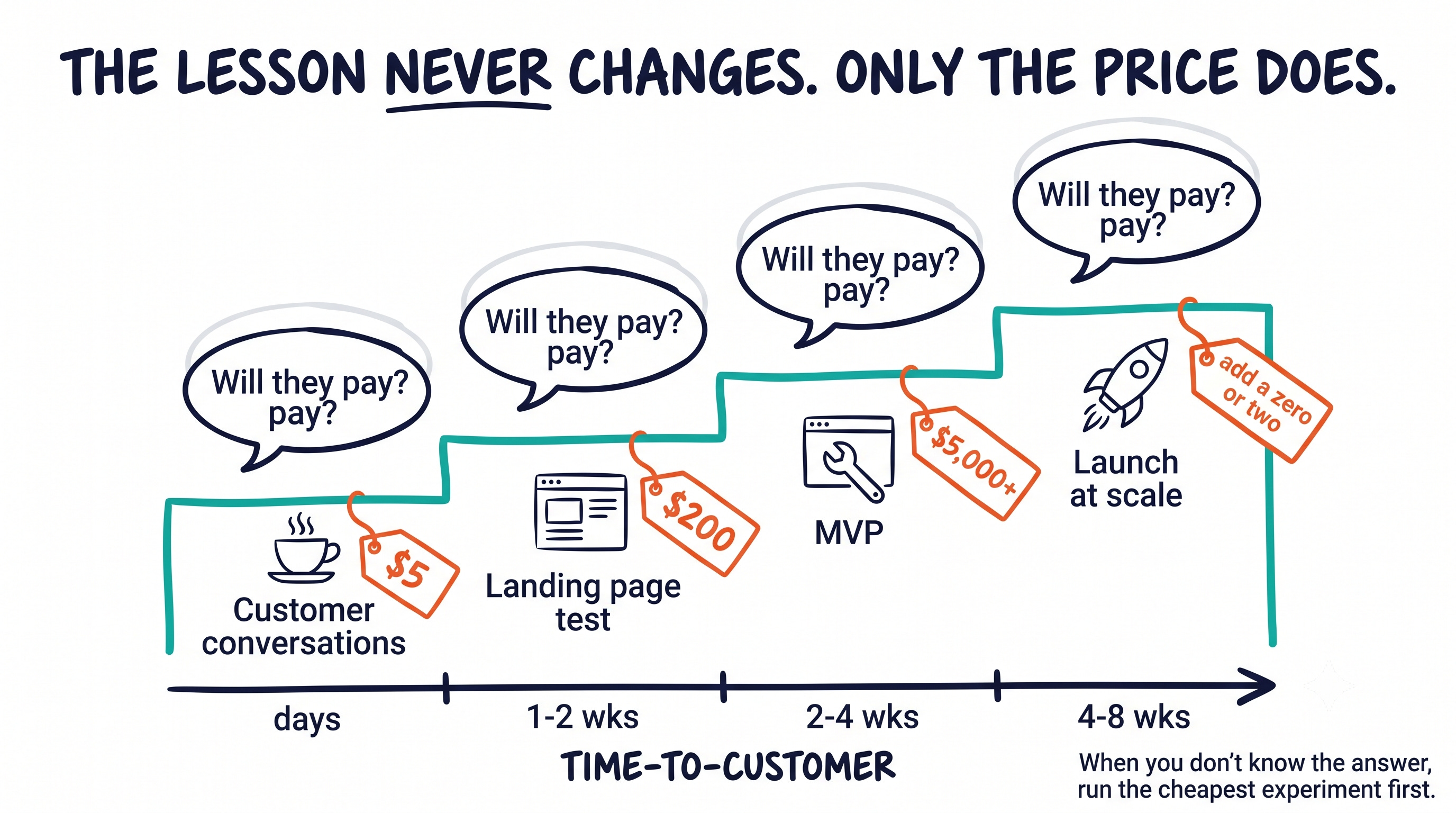
The cost of testing your kill-question depends on which rung of the Ladder of Evidence you’re standing on:
Customer conversations cost you time and coffee money.
A landing page test costs about $200 in ad spend.
An MVP costs you in the low thousands and up if you’re careful. Way more if you’re not.
Launching at scale adds a zero or two.
Now layer on the clock. We track a metric called Time-to-Customer: the elapsed time from “I have a hypothesis” to “I tested it with a real customer.” It’s the single most important velocity metric at the early stage, and it has stage-appropriate targets:
Discovery: days. The experiment is a 20-minute conversation.
Early validation: 1 to 2 weeks. Landing page plus a payment link.
Pre-seed: 2 to 4 weeks. An outbound cold sequence.
Seed: 4 to 8 weeks. A paid acquisition test.
Put the two together and the cost of procrastivity gets visceral. At discovery stage, the target is days and the price is coffee. Stretch the same test to three months and you pay for the answer with a brand identity, a landing page, and a quarter of runway. Stretch it past a full build and the identical answer costs $200K.
The lesson never changes. Only the price does.
One rule keeps you honest: your experiment should cost roughly one tenth of the decision it informs. A $50K build decision deserves a $5K test, not a $50K leap of faith. And when you don’t know the answer, run the cheapest experiment first.
Build the habit this week
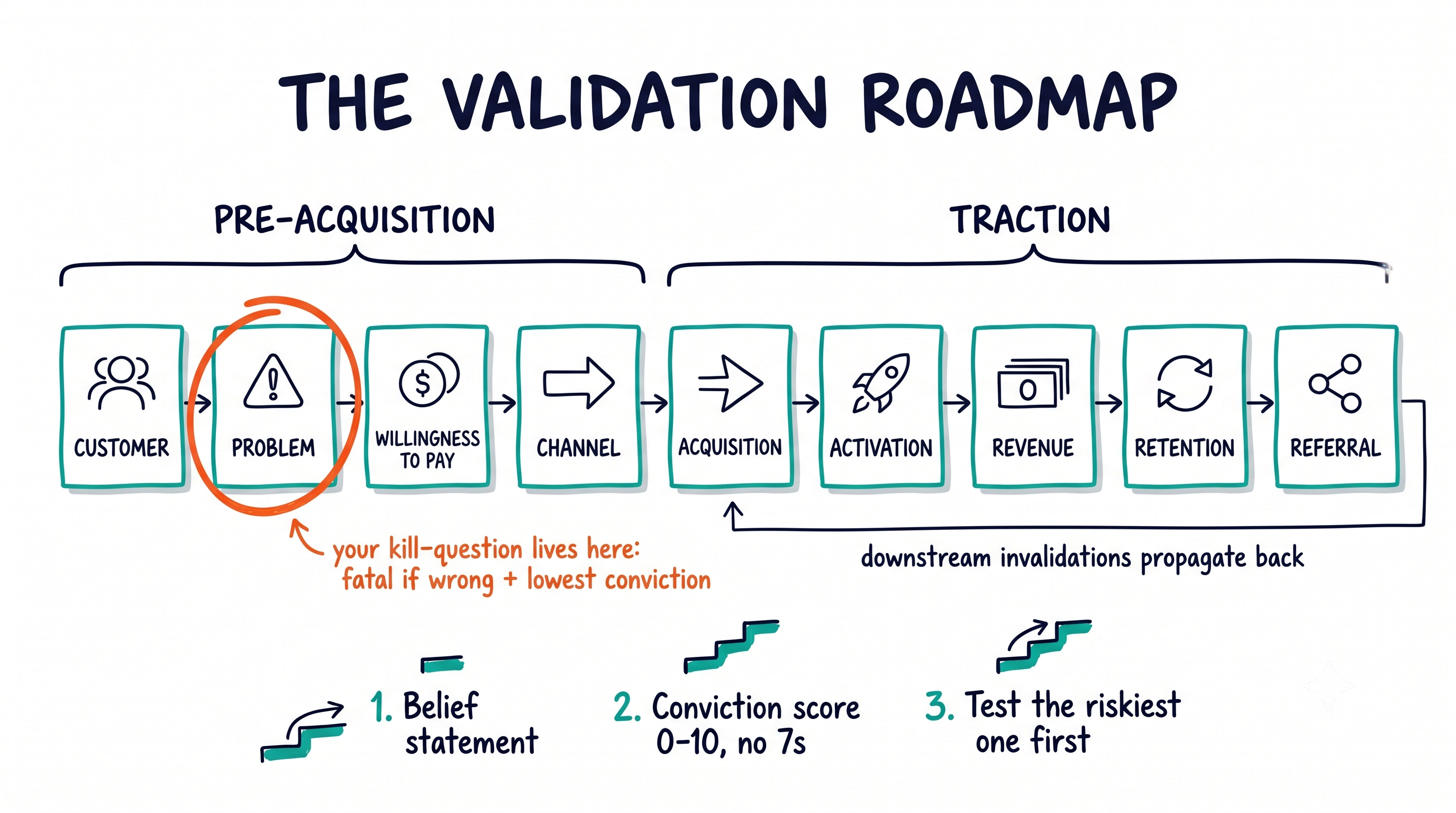
At Traction Lab we use a tool called the Validation Roadmap for exactly this. It lays out the nine stages every startup has to prove, in order: Customer, Problem, Willingness to Pay, Channel, Acquisition, Activation, Revenue, Retention, Referral. For each stage you write down what you believe and how much evidence backs it.
You don’t need the worksheet to start. A blank page works. Here’s the exercise:
Write one belief statement for each of those nine stages. “We believe there is a specific, reachable segment of people who...” and so on down the line.
Score your conviction in each from 0 to 10. No 7s. 7 is where founders hide from themselves. Force the call: are you confident or not?
Now circle the stage where two things are true at once: being wrong is fatal, and your score is lowest. That’s your kill-question. There’s exactly one.
Rewrite it as a falsifiable hypothesis. Specific, measurable, falsifiable. “People want our product” is an assumption. “At least 15% of qualified prospects will sign up for a paid pilot within 30 days of seeing our demo” is a hypothesis.
Then design the cheapest experiment that could kill it, and run it inside the Time-to-Customer target for your stage. Discovery stage means days, not weeks. If your plan to test it starts with “first we build,” you’ve already smuggled procrastivity back in.
You’ll be tempted to test something safer first. That temptation is the whole reason this habit is rare, and the whole reason it’s worth building.
Test what could kill you. Everything else can wait.
Want the worksheet we use with real companies?
Access the Validation Roadmap template → email cam@tractionlab.io
Until next week,
Cam
👍