


🧠 Stop betting the house on a maybe
Too many founders bet the whole roadmap on a compliment. Here’s how to size your startup bets to match the evidence — and avoid building a mansion on a maybe.


Hey friends 👋
Ever see a founder go all-in on a weak hand?
They hear a compliment, get a pilot meeting, ride a little social buzz… and suddenly, they’re doubling their burn, hiring a marketing team, and planning a 12-month roadmap.
No paying customers. We’ve all seen it.
The early energy is intoxicating.
Someone says, “This is cool — I’d totally use that,” and your brain turns that into revenue projections and Series A dreams.
But here’s a hard truth: Not all traction is created equal.
And if you size your bets based on hype instead of signal, you’re gonna burn your stack and find yourself aflame in the founder furnace.
JDM and I see this all the time.
So in this article, we’re breaking down one of the biggest founder mental traps — and how to avoid betting the house on vibes.
Let’s dive deep 👇
Let’s start with a mindset shift:
Traction isn’t a moment. It’s a trendline.
And your bets should match the slope.
In poker, amateurs make big bets on weak hands and weak data because they’re excited — or desperate.
Professionals?
They bet based on the ratio of risk versus reward — and they know that one lucky card doesn’t make a strong hand.
Founders often mistake one moment of “validation” for traction:
A pilot program (no intent to convert into becoming a paying customer)
A set of waitlist signups (are they actually waiting or just on an email list)
A they said they would buy it if we just built this one feature!
They mistake these data points for a green light to double down.
But the reality? They’re going all-in on a pair of twos.
Pre-flop.
Smart founders do something different: they look for the trendline.
They look for data compounding over time.
One customer “yes” doesn’t justify a product roadmap. One thumbs up at a demo doesn’t mean you’ve nailed your go-to-market.
These are clues, not conclusions, and your next move should reflect the strength and shape of your evidence.
Instead of treating traction as a binary (we have it or we don’t), treat it as a slope or ladder — a pattern building on itself.
We want a consistent curve of increasing validation from the market:
Are customers deepening their engagement?
Are new users showing up organically?
Are signals getting stronger, more frequent, and more behaviorally rooted?
If the slope is shallow or flat, that’s not a sign to scale — it’s your cue to do the opposite: keep testing, learning, and listening.
It’s time to make smaller, faster bets: tighten your experiment cycles, refine your message, interview more customers.
Because early traction is full of false positives: pilot interest that doesn’t convert, users who love your product but never pay, applause that flatters but doesn’t fund.
Here’s a better mindset:
A single data point is a clue.
A consistent curve is a case.
Each new signal is a chapter.
At Traction Lab, we teach founders to treat traction like a regression line, not a highlight reel.
Read the arc, and place bets that match the plot.
When the story’s still unclear, make small bets. When the story starts to sharpen, start investing more. When the market is pulling you in, that’s when you sprint.
Bet on the slope. Not the spike.
And the most common spike?
Confusing excitement for evidence
Founders get hyped on energy. Investors bet on proof.
One of the most common missteps we see in early-stage founders? Mistaking excitement for evidence — vibes for validation.
You demo your idea. Someone smiles, nods, says, “This is cool.”
Suddenly, you’re sprinting to build out the full product suite.
Six months and thousands of dollars later, you realize no one’s actually using it or worse, no one’s paying for it.
But excitement ≠ investability.
Just because someone liked the idea doesn’t mean they need it, want it, or will ever buy it.
In the chaos of startup life, shallow praise can feel like gospel — especially when you’re starving for signal.
That’s when the danger sets in: your roadmap starts being driven by adrenaline, not actual data.
It’s just startup dopamine. Get your hit on Instagram instead.
Don’t chase applause. Chase irrefutable evidence:
Did someone pay you? Did they pay you at the price you plan on offering it in the future?
Did they come back? Are they using it and gaining value?
Did they refer someone else? Are they retained as users/customers?
Did they change their behavior because of what you built? How is their life better?
Those are signals that matter. The ones you bet on.
At Traction Lab, we remind founders: You’re not here to feel good — you’re here to find out what’s real.
Don’t waste your runway on flattery dressed as feedback.
Validate with proof.
Here’s how:
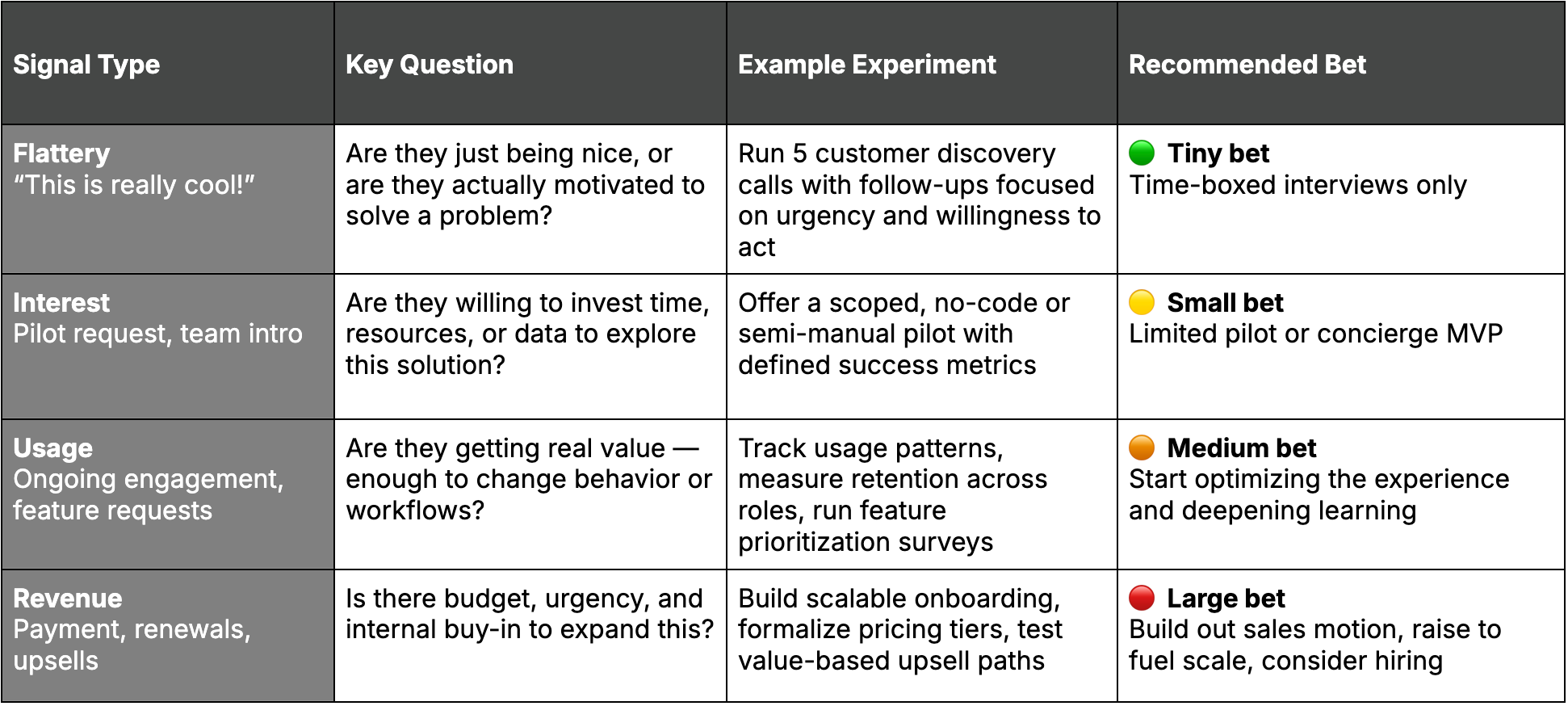
We love a good matrix.
You can use signal strength to guide your time, money, and energy.
Startups don’t fail because they move too slowly. They fail because they bet too big — and too early — on the wrong signals.
The trick is knowing what kind of signal you’re looking at.
Not all traction is created equal. Some signals mean “run another test,”while others mean “scale the motion.” Your job as a founder is to read the signal correctly — and size your next bet accordingly.
The Danger of overcommitting on weak signals
Overcommit early = slow death later.
Failed experiments don’t kill startups.
False confidence and living on vibes do.
We’ve seen founders go all-in after a single “yes,” only to burn six months (and a chunk of runway) building features no one else wanted.
(We got a paying customer though!)
Take an early-stage HR tech startup that landed a pilot with a mid-size enterprise.
They spent weeks customizing dashboards and integrations only to find out the buyer had no budget authority and wasn’t the real decision-maker.
The “pilot” never converted, and the roadmap became hostage to a one-off, extra-long product demo.
The traction was anti-traction.
Take another startup which has a sales enablement tool. They keep saying yes to feature requests from scattered industries — healthcare one week, real estate the next — all in an attempt to “capture more of the market.”
The result?
A Frankenstein’s monster of a product no one could navigate with no clear path to repeatable sales.
Why does this keep happening? Aren’t they following signals from the market?
No.
Because building for every “maybe” leads to bloated products that solves everything for no one in particular.
Worse, you lose sight of your ideal customer — the one your business model is designed to serve repeatedly and scalably.
It’s better to underbuild for a no than to overbuild for a maybe.
Under-building leaves room to learn. Every “no” helps us define who is not our customer, while every “yes” is a strong signal we’re on the right path.
Overbuilding traps you in complexity and confusion, like trying to build your way out of an endless pit.
But a golden rule of entrepreneurship is that your job is not to please everyone.
Your job is to validate a repeatable, scalable solution for a specific customer segment, and to double-down only when the signals support it.
Traction isn’t measured in effort.
It’s measured in evidence.
Early-stage entrepreneurship is emotionally messy: ambiguity, rejection, and a lingering fear that you’re wasting your time.
So it’s natural for founders to seek comfort in clarity-adjacent activity — what we call procrastivity — work that feels productive because it’s visible and tangible, but doesn’t move the needle.
No confirmation of the pain, but you’re roadmapping features.
No validation of the value prop, but you’re refining your logo.
No paying customers, but you build the landing page.
These things feel good. They’re shippable. Shareable. Screenshot-ready.
But they’re not traction.
It’s just startup theater.
Take an AI startup building a “smart assistant” for internal knowledge management at large enterprises.
They had great demos and people loved the UI, praised the tech, and said “this would be so helpful!”
So the team doubled down: polished UX, added features, and built an onboarding workflow.
The problem?
They hadn’t validated who actually owned the problem — or the budget for solving it. The excitement was coming from middle managers and end users, but not economic buyers.
Six months in, the team had overbuilt a product for a customer that couldn’t say yes.
Lots of activity. No traction.
This is what we call misreading the table: overestimating the strength of the signals in front of you, because they make you feel like you’re moving.
It’s not just about optimism… it’s bias.
Founders are emotionally invested. Passionate. Obsessed.
It’s one of your superpowers.
But passion also distorts. It makes weak signals feel stronger than they are. It mistakes:
Polite compliments for customer interest
Social likes for leads
Pilots asks for roadmaps
That’s why “bet sizing” — and frameworks like the one you’re reading — matter. They help you see clearly when your instincts are muddy.
Before you pour another week into polish, ask yourself:
Is this a bet based on evidence — or adrenaline?
Because if you’re betting on what feels good, you’re not building a company — you’re burning runway for applause.
Play the hand, not the hype.
Build experiments that generate real signals, and only bet bigger when the signals are strong.
Founders often feel pressure to act like they’ve already won: pitch big, build boldly, and scale fast.
But hype isn’t a strategy. It’s a distraction.
The smartest founders aren’t swinging for the fences on every turn — they’re making small, calculated bets to test what’s real.
They run fast, cheap experiments.
They talk to customers.
They ship tiny versions of their ideas — just enough to learn something concrete.
You’re not trying to look like a successful company.
You’re trying to become one.
That means building a system that learns.
You’re searching for patterns — repeated behaviors, real payments, retention, referrals. Those are your strong hands.
And when you finally start hitting signal after signal? That’s when you raise the stakes.
Founders who thrive aren’t the ones who gamble big on dreams — they’re the ones who read the table, test the waters, and double down when the evidence says go.
So stop chasing hype. Start placing smart bets.
Let the data — not your pitch deck — tell you when to go all in.
Traction is a Portfolio Strategy
Experiments are testable investments, and your time is your first capital.
Before any angel check or VC term sheet, there’s always one investor who shows up first: you.
The founder.
Your first investment isn’t money. It’s time — and time is the most precious resource you have. You can’t raise more of it. You can’t borrow it.
Once it’s gone, it’s gone (and so are you).
That’s why every founder needs to act like an investor from day one.
Because you already are one.
Too many early-stage founders behave like builders chasing a to-do list.
They think progress is measured in features shipped or lines of code written. But in reality, every decision is an investment in a possible future and the best founders know how to manage their portfolio of bets.
Let’s make it practical:
A B2B SaaS founder had early interest from a few HR teams in mid-sized companies. Instead of building the full platform right away, she ran a series of lightweight pilots, using no-code tools to simulate the product’s core experience. As she gathered data, she cut low-signal features and focused on the ones that kept showing up in usage patterns and conversations.
The result?
She ended up spending less than 20% of her original budget and closed two paid pilots — in under 90 days.
That’s founder-as-investor thinking.
Contrast that with another early-stage founder who got excited by initial buzz around their AI-powered sales enablement tool. After a few “this is cool” responses from LinkedIn connections, they went heads down and built out the full feature roadmap: analytics dashboard, Slack integration, user permissions — the whole suite.
Six months later, they were out of time, out of cash, and no closer to a paying customer. They invested like it was a sure thing — but they hadn’t tested the hand.
This is the trap: acting like a builder when you should be thinking like a portfolio manager.
Every experiment is a testable investment.
You’re not just validating ideas… you’re allocating limited capital (your time, focus, and energy) toward possible futures.
Your job isn’t to predict the winning bet. Your job is to discover and validate it.
Start small:
Run fast, cheap experiments that test your riskiest assumptions.
Track which generate real signals — not interest, but behavior.
Cut what doesn’t move the needle.
Only scale what’s working.
And remember: effort ≠ evidence.
Just because you spent a month building it doesn’t mean it deserves another.
Every hour you spend should move you toward clarity — not complexity.
The founders who win aren’t the ones who hustle hardest.
They’re the ones who invest wisely. Who manage risk. Who treat their time like the first check in the round.
Because in the end, it’s not just about gaining traction — it’s about how you earned it.
And whether your first investor — that’s you — got a return.
Bet on vibes… or data?
Before your next sprint, pause.
Ask yourself: are you betting on a strong hand — or just high hopes?
Are you building because the evidence says go? Or because your gut says maybe?
Startups aren’t powered by passion alone.
They’re powered by pattern recognition: by spotting real signals in the noise and placing proportional bets.
Weak signal? Probe deeper. Run a test. Get sharper.
Strong signal? Place your chips. Push harder. Scale smart.
And if you’re not sure?
That’s exactly what we do at the Traction Lab. We apply rigor through traction science and traction thinking to support you in gaining the validation you need to hit your next major milestone.
We help founders stress test their assumptions, break down what’s real (and what’s risky), and figure out whether they’re operating on validation or vibes.
Because moving fast is only useful if you’re pointed in the right direction.
Don’t waste time building a pretty product for a lukewarm maybe.
Ready to test your bet?
If you want to know whether your next move is a smart bet — or just startup theater — we’ve got a 15-minute gut check that might save you a year of misfires.
You bring your roadmap. We’ll bring the frameworks, the poker face, and the call that saves you six months.
→ Book a traction stress test with us.
Let’s make sure you’re betting on data — not dreams.
Don’t bet the house on hope.
See you next week,
—Cam & JDM