
Stop counting yeses. Start counting commitments.
Enthusiasm is free. Intent costs something. Here's how to tell which one you're measuring.

Hey friends 👋
You’ve done the work by talking to dozens of potential users. You’ve filled up a spreadsheet with enthusiastic quotes: “I’d definitely use this” or “I’d pay for that.” You have translated that onto your pitch deck slide titled “Validation or Traction”. So you built it.
Then the moment you have been waiting for: the BIG launch… And almost no one signs up.
You tried hard. You measured the wrong thing. You asked the right people the right questions and listened carefully, but you made a mistake that puts more startups in the startup cemetery than any other:
You confused interest for intent.
Everyone who said they’d use your product meant it — in the moment. But they were projecting a future version of themselves that they are not likely to realize, at least currently. This version, for example, would finally get organized, finally fix that workflow, finally do the thing they know they should do. But that future self doesn’t exist, and building for a fictional customer is expensive and can cost you your startup.
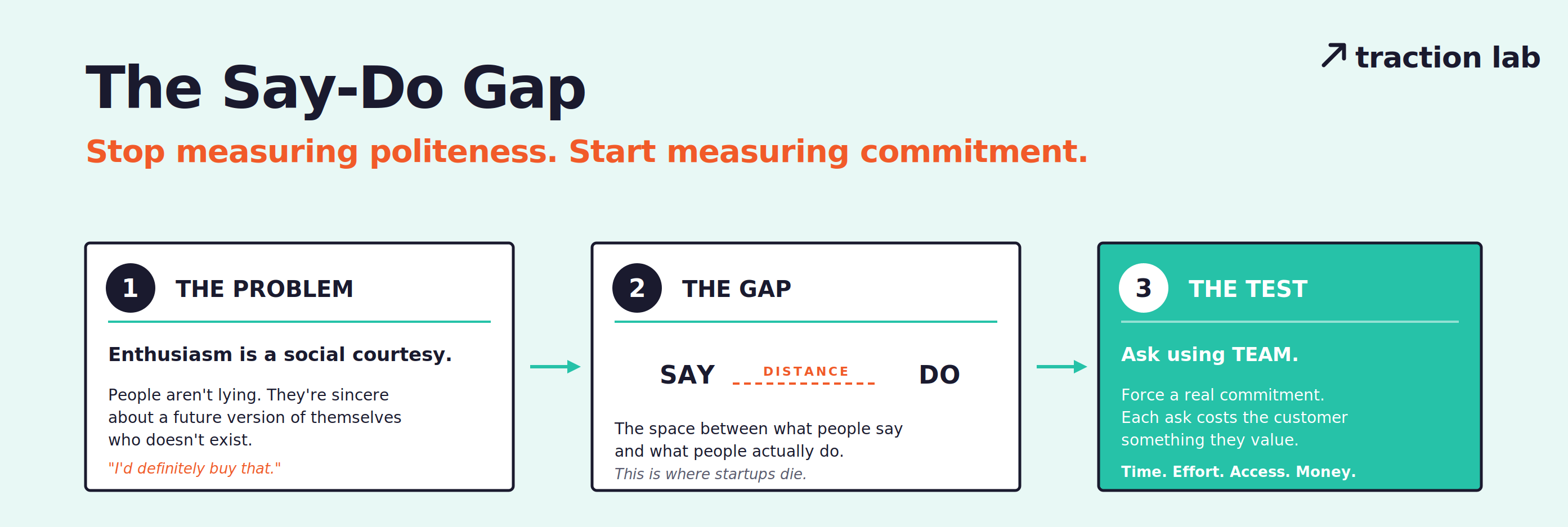
It’s called the Say-Do Gap. It’s the distance between what people say they’ll do and what they’ll actually do. And for founders, it’s the difference between traction and the trough of sorrows.
Let’s dive deep 👇
The Say-Do Gap is actually a feature.
Decades of behavioral research confirm that people are genuinely bad at predicting their own future actions. We overestimate our future motivation, underestimate friction, and consistently fail to account for the dozen competing priorities that will crowd out any new behavior.
When someone tells you “I’d definitely buy that,” they aren’t lying to you. They are doing something worse which is that they are being sincere about a hypothetical version of themselves. And hypothetical customers don’t pay.
The problem compounds because founders want to believe that every “yes” is validation. Every enthusiastic response gets added to the tally. But you’re not counting customers — or even potential customers. You are instead counting compliments and burning cash on product development with no revenue to show for it.
The progress of systematically acquiring evidence can take the form of the Ladder of Evidence. At the bottom of the ladder or weaker forms of validation. These are signals around the problem being urgent and severe whereas when you move up the ladder we are seeing true intent not just interest.
So how do we address human behavior and distinguish between interest versus intent?
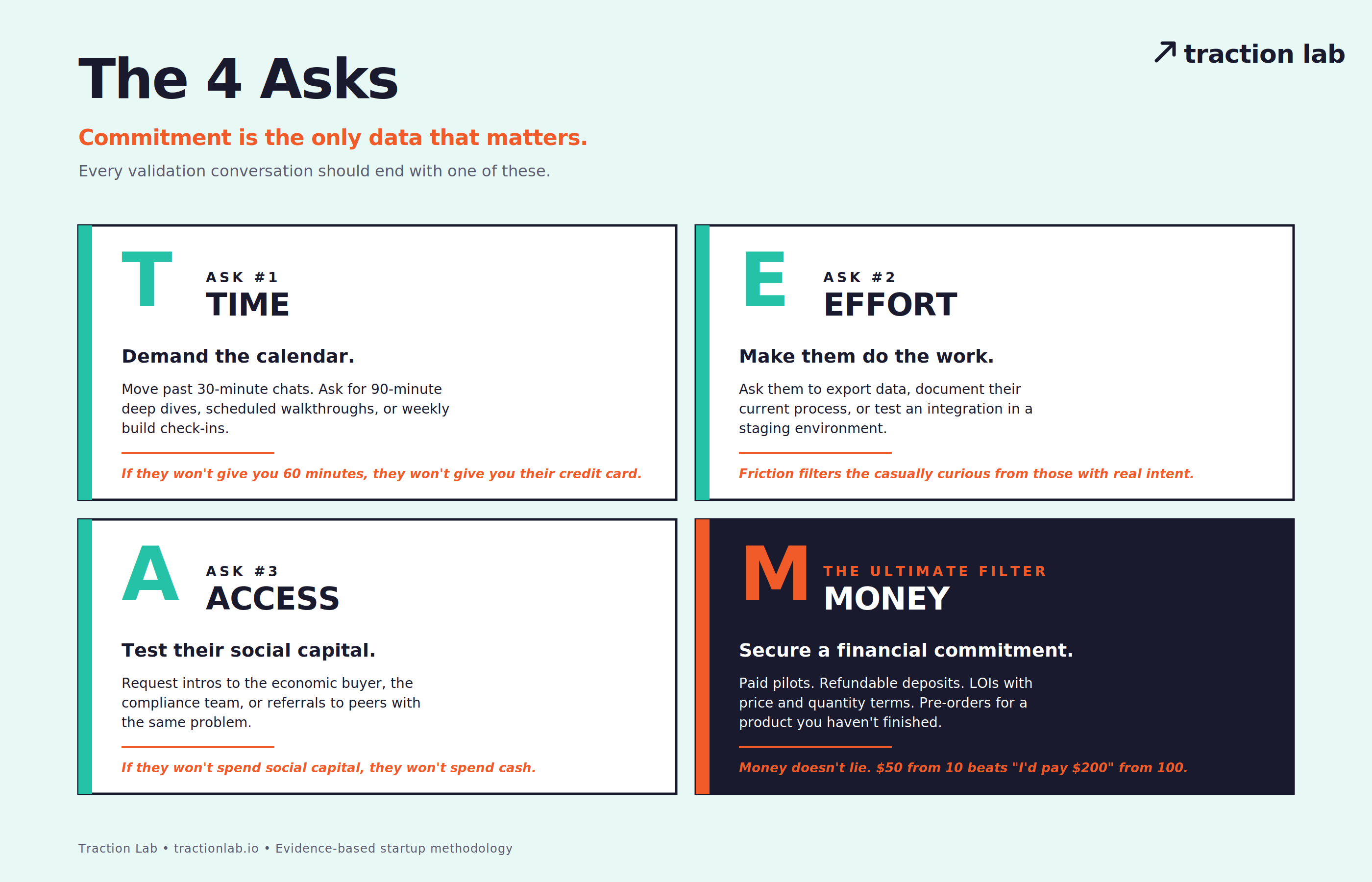
Close the gap with The 4 Asks: Time, Effort, Access, Money
If words aren’t reliable in measuring intent then… what is? Action. Specifically, actions that cost something.
The TEAM framework gives you four currencies to test intent. Each one asks the customer to put something real on the table and move from interest to intent.
T - Time
Will they schedule a follow-up call? Will they commit 60 minutes to a prototype walkthrough next week? Will they show up?
Time is the first gate to see if there is intent. If someone won’t give you 60 minutes of their calendar, they’re not giving you their credit card. This signals the problem is not big enough nor urgent enough for them to be a customer.
E - Effort
Will they fill out a detailed onboarding survey? Will they make the necessary data integrations required to get value from your offering? Will they dig up data from their own systems to help you understand their workflow?
Effort creates friction and this friction filters out the casually curious with those that have true intent.
A- Access
Will they make an introduction to the boss that signs the check? Will they refer you to others like them that have “the problem”?
By asking for access you are testing their willingness to spend social capital. If they aren’t willing to part with social capital are they really going to be willing to spend money.
M - Money
The ultimate filter. Will they put down a deposit? Pre-order? Letter of Intent (LOI) with terms outlining price/quantity? Pay for early access even if the product isn’t finished?
Money doesn’t lie. A $50 commitment from 10 people tells you more than “I’d pay $200” from 100 people.
Each TEAM ask moves you up the Ladder of Evidence. Each one supports you in crossing the conviction chasm of the Say-Do Gap. But don’t stop at Time and call it validation. Work your way up the Ladder of Evidence to Money.
Investors are allergic to “interest.”
Investors see through “we have interest” startup theater. When you tell them “50 people said they’d buy,” they’re already discounting it to zero and asking themselves what they are still doing in the room. When you tell them “12 people put down a $100 deposit before we built anything,” that’s a different conversation.
The intent you gather from the 4 Asks: TEAM become your evidence and are much stronger than quotes of interest (even if you have a large amount of them). They show you understand the difference between enthusiasm and demand. They see that you are a founder building on validation not vibes. They show you’re building for real behavior, not hypothetical preference. They show you’re the kind of founder who doesn’t need to learn expensive lessons twice.
The Say-Do Gap doesn’t get solved once. You apply it to every conversation. Every validation conversation should end with a TEAM ask. Our goal is to measure intent not interest. Every positive signal should be tested with a cost. So ask them to pay in one for forms of Time, Effort, Access, or Money.
At the end of the day, the path to “no” is more valuable than a pile of fake yeses. Every person who won’t give you their time is telling you something useful. Every person who won’t give you their money is clarifying who your customer isn’t. That negative space is a gift. It shows you where not to build, where not to spend, and who not to chase.
A quicker path to no is a faster path to the right yes.
So don’t bet the farm on “interest.” Talk is cheap. Commitment costs something. The gap between them is where your validation lives or dies.
Close the gap. Ask using TEAM. Gather intent versus interest.
Until next week,
Cam
Nicely stated.